There is nothing wrong with you
You are at a stage. It has a name, and there are six others.
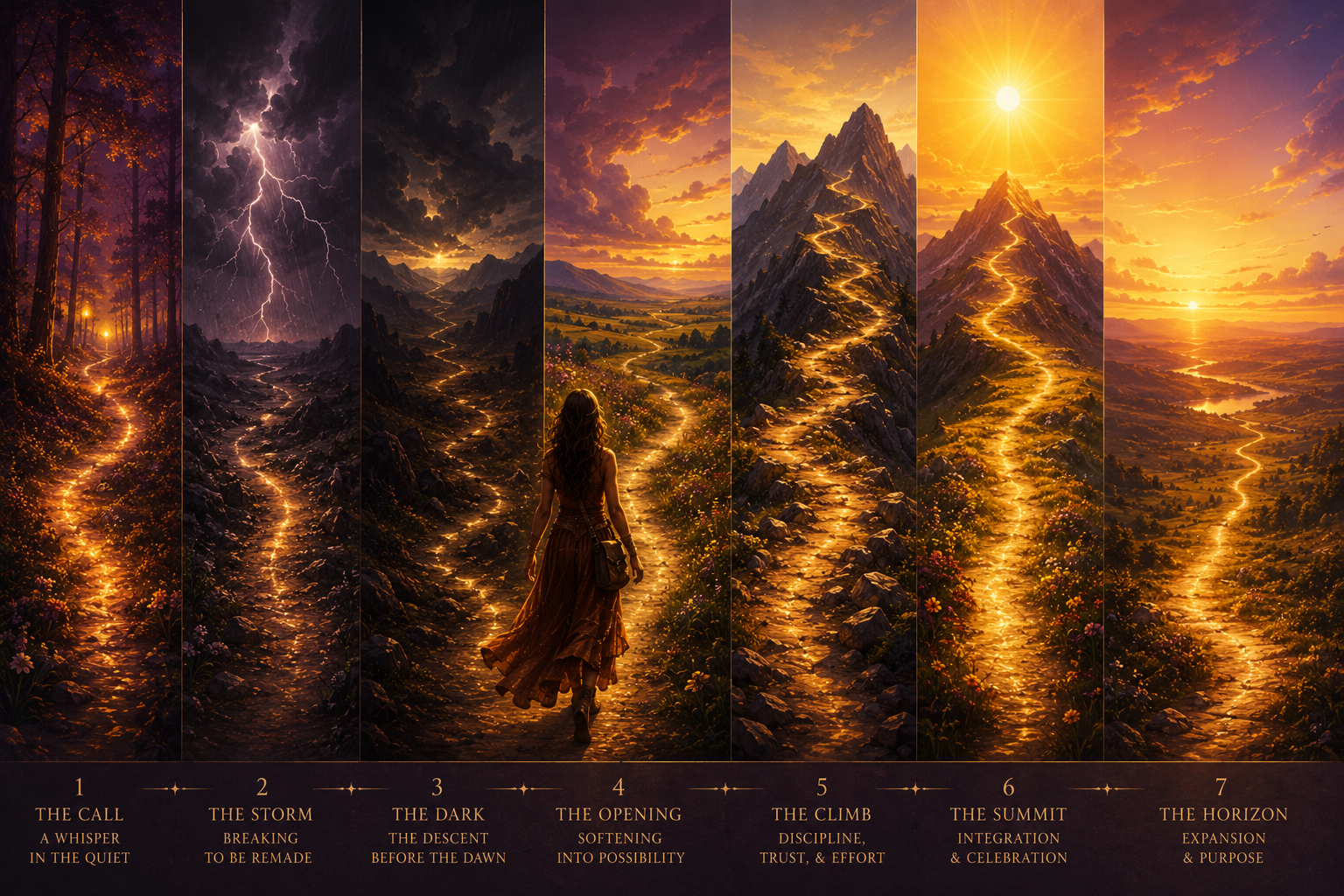
Self-paced mini course · Seven stages · Three tools · $44

You have been googling your own symptoms at three in the morning
The sleep went first, or maybe the appetite. Then things you used to care about stopped mattering, and things you never thought about became urgent. Old friendships got quiet. You cried at something small in the car.
You have looked up thyroid conditions, burnout, perimenopause, depression, and whether it is possible to have a nervous breakdown slowly. Some of what you found fit. None of it fit all of it.
The people around you have opinions. Somebody thinks you should see a doctor. Somebody thinks you have changed. Somebody has started being careful with you in a way that is worse than if they just said it.
And underneath all of it is the question you have not said out loud: is this a spiritual thing, or am I losing it?
It has a shape, and almost nobody tells you that
An awakening is not one event. It moves through stages, and the stages come in an order.
Each one has its own symptoms, its own particular misery, and its own reason for happening. The stage where everything falls apart is not the same as the stage where nothing means anything, and both of those are different from the stage where you feel wide open and slightly unhinged with joy and cannot explain that to anyone either.
Almost every person going through this thinks they are the only one, that it is permanent, and that it is happening at random. All three of those are wrong, and being wrong about them is most of what makes it unbearable.
What I did not have when it happened to me was a map. I had a stack of books that each described one piece of it, none of which said what order anything came in or when it would stop. I built this because I could not find it.
A self-paced mini course that walks through all seven stages of a spiritual awakening.
It opens with a quiz that locates you. Not a personality quiz. A set of questions that tells you which stage you are actually in, which for most people is the single most settling thing in the whole course.
Then each stage gets its own guide. What it is, what it feels like from the inside, what tends to happen in your body and your relationships and your work during it, how long it usually lasts, and what actually helps while you are in it.
Three practical tools sit inside it for the hard moments, along with a ten-minute practice for the end of the day, which is for putting down what is not yours and sleeping in your own energy again.
And each stage tells you what comes next. Which is the part people say they read first, because when you are in it, the only thing you actually want to know is whether it ends.
At a glance
• A quiz that tells you which stage you are in
• All seven stages, each with its own guide
• What to expect in your body, your relationships, and your work at each stage
• Three practical tools for the hard moments
• A ten-minute nightly practice for putting the day down
• What comes next after each stage, so you know it moves
• Self-paced, yours to keep, go at whatever speed you can manage
What is different afterward
The fear goes down. That is the first thing, and it happens fast, usually during the quiz.
There is an enormous difference between an experience that is happening to you for no reason and an experience that has a name, an order, and an end. The symptoms may not change at all that week. How much they cost you changes immediately.
You stop pathologizing yourself. The three in the morning searching stops, because the question it was trying to answer got answered.
You get language for your people. Most of the loneliness in this is not being alone, it is being unable to explain. When you can say I am in the stage where the old life stops fitting and here is what that involves, the person across from you can meet you instead of worrying about you.
You stop fighting the stage you are in. A lot of the suffering in an awakening comes from trying to force yourself back to who you were in the middle of a process that is specifically dismantling that. Knowing which stage, you are in tells you what is worth resisting and what is worth letting happen.
And when the next stage arrives, and it will, you recognize it. That is the part that keeps being useful long after you finish. People tell me they went back to it a year later when something shifted again and found the section that described exactly what was happening.
This is for you if
• Something is happening to you and you cannot tell whether it is spiritual, medical, or psychological
• You are in the middle of it right now and you mostly want to know whether it ends
• You have read pieces of this in twelve different places and never seen the whole shape
• The people around you are worried and you cannot explain it to them
• You want a map more than you want a program right now
This is probably not for you if
• Your symptoms are new, severe, or worsening and you have not seen a doctor. Please do that. A map is not a diagnosis and I would rather you had both
• You want somebody to work with you directly. This is self-paced and there is no call attached to it. The sessions are where direct work happens
• You already know your stage and what you actually want is the practice underneath it. That is the Self-Spirit Method, and this course will feel like ground you have covered
-
About two hours if you go straight through. Most people do the quiz, read their own stage, and come back for the rest over a few weeks, which is a completely reasonable way to use it.
-
Common, and the quiz accounts for it. The stages overlap at the edges and people often sit in two at once. Read both.
-
No. Nothing in it requires a belief system. It describes what happens and what helps.
-
No. This tells you where you are. The Self-Spirit Method is the fourteen step process for doing something about it. This one is a map and that one is the road. You do not need this before that, and plenty of people do one without ever doing the other.
-
Not built into this one. It is self-paced and self-contained by design, which is part of why it is $44. If you want direct help, a session is the place for it.
This is a complete thing. There is no next step you are expected to buy and no sequence it belongs to.
If it turns out that what you want after reading it is the actual practice, the Self-Spirit Method is where that lives, and I will not pretend otherwise. But finishing this and never speaking to me again is a perfectly good outcome and it is the one most people have.
The Awakening Roadmap
$44
Seven stages, three tools, and a quiz that tells you where you are.
Yours to keep, at your own pace.